Lesson 2: Personality, Essence, Ego
PENSUM
- Children’s Consciousness
- The nourishment of Personality and Essence or Consciousness
- Personality and Basic Education
WHAT SHOULD BE TAUGHT:
- The difference between Personality, Essence and Ego. Explanation of what each of these three are.
- Wrong relations in the harmonious work between Personality and Essence.
- The EGO as the cause of the sleeping consciousness. The necessity to un-liberate it through the EGOs in which it is imprisoned by conscious effort and in a concrete way.
- The child: The formation of the child’s Personality and how the EGO manifests itself through the personality when it has been formed.
- The ways of communication (TV mainly). The example of adults, school, etc. in the formation of the child’s personality.
- The food of the Personality and the food of the Essence.
PRACTICE: OBSERVER AND OBSERVED (very clear explanation)
In this course we will study the basics of inner psychology and work on ourselves.
- Internally we consist of 3 parts: Personality Essence Ego
Personality
(See “Lectures of a Great Mystery 3”, lecture “Essence, Ego, Personality”) (See “Basic Education”, chapter “The Human Personality”)
- When someone is born, he has no personality.
- Personality is gradually created by the examples and impressions we receive from our surroundings:
- Home
- School
- External influences (the streets)
- Allows us to interact with our environment.
- i.e. to know how to speak, read, write, dress, eat with a fork, operate an electronic device, drive a car, etc.
- i.e. a man brought up in a wild state, far from civilization, would not know how to do any of these things.
- Personality belongs to time.
- It is created by the effects of the place and time where we are born and allows us to adapt to these conditions.
- When the physical body dies, the personality slowly dissolves.
- In every life we create a new personality: we could not adapt to new conditions with an old personality (i.e. the personality of an ancient Roman could not adapt to New York of the 21st century).
- It is an energy vehicle that allows the expression of the Essence or “I”.
- Wise teachings, good examples and influences, create a personality through which it is easier to express the values of Consciousness.
- i.e. teachings and examples of charity, understanding, patience, compassion, humility, generosity, etc.
- Bad examples and influences create a personality through which it is easier to express the “I”.
- This is the false personality.
- i.e. examples of anger, fighting, arrogance, jealousy, lust, greed, revenge, stealing, etc. (see T.V.)
- Personality normally develops up to the age of 7.
- Now this happens sooner, around 4 years, due to the bombardment of stimuli that the child receives from an early age.
- After this age it does not develop any more, it is simply strengthened by the various experiences of life.
Essence
(See “Revolutionary Psychology”, chapter “The Essence”)
- It is a small piece of the Human Soul that we have embodied.
- The Being unfolds into the Divine Soul, the Divine Soul unfolds into the Human Soul, and the Human Soul sends a piece of itself into the 4 Bodies of Sin (Physical, Vital, Astral, Mental).
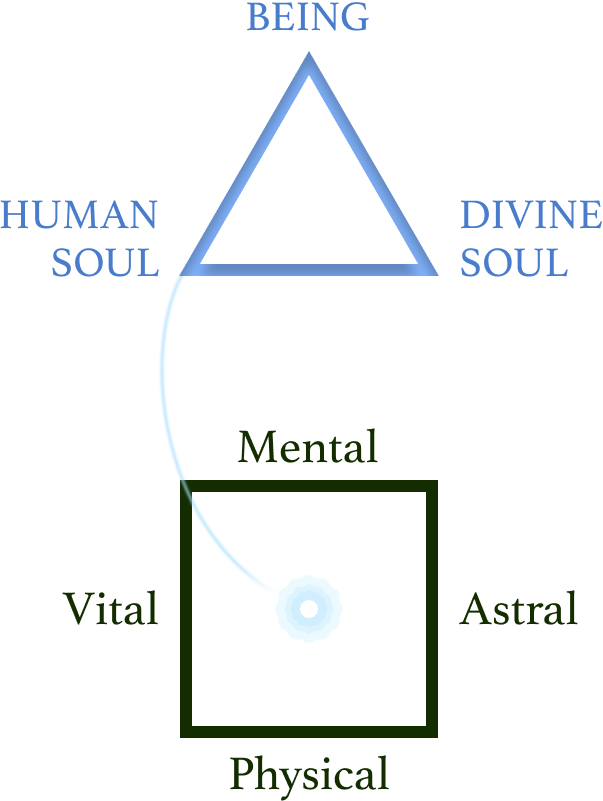
- Also called: Embryo of Soul or Buddhata (Zen Buddhism).
- Essence is the best and noblest thing we have within us.
- It is what allows us to have true love, compassion, freedom, peace, etc.
- Seers see her as a very beautiful blue creature.
- Essence is immortal.
- After the death of the physical body, it continues and reintegrates into a new organism.
- Develops only in the first 3, 4 or 5 years of life.
- The sooner “education” intervenes and the various stimuli of culture (television, tablets, etc.) the sooner the development of the Essence stops.
- Internal work is necessary to develop further.
- The Essence is easily seen in infants and small children.
(See “Revolutionary Psychology”, chapter “Child Self-Consciousness”)
- Seven seconds after birth, with the baby’s first breath, Essence enters the physical body.
- It is already connected in advance with the sperm that does the fertilization by the Angels of Life.
- When released and developed it turns into the Soul.
- Then it provides us with various supernatural abilities, such as:
- Intuition
- Clairvoyance
- Clairaudience
- Telepathy
- Astral travel
- Etc.
- Then it provides us with various supernatural abilities, such as:
Essence-Personality Balance
- Essence is what is ours while personality is what we obtain from outside.
- Substance and personality must develop equally:
- If the personality develops more than the Essence, the result is an “impostor”, a man without the values of Consciousness.
- If the Essence is developed more than the personality, the result is a man with a noble heart, but incompetent and maladjusted.
- Essence feeds on tenderness, love, music, flowers, beauty, harmony, etc.
- Working internally we develop Essence through the death of “I”, conversion, sacrifice, prayer, meditation, etc.
- The personality is nourished by good examples, by wise teachings, etc.
- Relationship between Essence and personality:
- When we are infants the Substance is active.
- As the personality is created, the Essence begins to become passive and the personality active.
- i.e. to many “educated” people the Essence is almost never expressed. Everything we see in them is personality, i.e. “not theirs”.
- With the inner work we must transfer our center of gravity to the Essence, so that it becomes active again and the personality becomes passive (that is, to be the servant of the Essence and not its master).
Ego
(See “Revolutionary Psychology,” chapter “The Beloved Ego”) (See “Parsifal Unveiled”, chapter “Poppy”)
- Each “I” personifies a psychological defect of ours.
- We do not have a single “I”, but many small “I”.
- The various “I’s” do not have any coordination or cooperation with each other.
- Each little “I” thinks it is the whole, the master, and tries to take control as often as possible.
- We are like a house where the master is absent and every servant wants to do what he likes.
- This is why people “change their minds” so often.
- This is the cause of all our psychological conflicts.
- i.e. one “I” wants to insult his boss, another “I” is afraid of being fired, a third “I” just wants to go home and watch TV, etc.
- Each “I” has trapped a piece of our Essence.
- Humanity has an average of 3% free Substance, and 97% trapped
- This 3% also symbolizes the three atoms that we have within us that the “I” cannot contain (The person of the Father, the Son and the Holy Spirit).
- If the case of a man is lost, the Being absorbs these three atoms and cuts the connection with the 4 Bodies of Sin. Then man turns into a quaternario.
In the First Chamber we cannot talk about the quaternario because it is very difficult to digest without having a level of understanding.
- If all humanity had 10% free Substance, there would be no wars.
- Every time we dissolve an “I” the part of our Essence that was trapped inside it is released.
- In all ancient traditions were taught about the “I” and its dissolution:
- Christianity: demons
- Buddhism: psychic aggregates
- Egypt: the red demons of Seth
- Hinduism: passions and desires
- Mythology & fairy tales: beasts, monsters, dragons, etc.
- When the personality is not yet formed, the “I’s” cannot enter the child’s body.
- They wander around the crib, and many times the child gets scared and cries when he sees them.
- That is why, while the child is initially very beautiful and pure, after a point he begins to change psychologically.
Killing of the “ego”
(See “Psychological Death”, chapter 1)
- To dissolve an “I” there are 3 steps:
In this lesson we will talk about the 3 steps in general. In lesson 4 we will talk in more detail, and in lesson 17 in even more detail.
1. To discover it
- It is impossible to dissolve an “I” that we do not know we have.
- As long as we have not discovered an “I”, we think that something external is to blame for the problem that causes us.
- The “I” is discovered through self-observation.
2. To comprehend it
- Comprehension releases the Essence trapped in the “I”.
3. To dissolve it
- After we have understood the “I” and released the Essence it had trapped, we must dissolve the “shell” that remains.
Practice: Self-observation
(See “Revolutionary Psychology,” chapter “Observation of the Self,” “Observer and Observed,” and “The Two Worlds”)
Here we will give individuals the first practice: self-observation.
- It is one thing to “know” and another to “observe”.
- “To know” is passive (e.g. someone knows that he is angry)
- “To observe” is active (eg someone observes his anger)
- Self-observation is a method to discover and study the “I”.
- Self-observation is like shining a light inside ourselves to see what is going on.
- In order to observe ourselves correctly, we divide ourselves into observers and observed.
- The observer is the Essence and the observed is whatever happens within us.
- That is: we observe our thoughts, our feelings, our reactions, etc. as if we were observing something foreign.
- If we are not separated from what we observe, it means that we are identified with it.
Recommended Practice
- At the end of the lesson we can do a short guided practice:
- First, we do some deep breathing, relaxation, etc.
- We concentrate on the heart and try to get in touch with our Essence, seeing it as a beautiful blue flame that gives us peace, love, harmony and happiness.
- We notice the difference between the Essence we feel in the heart and the “I’s” that speak to us through the mind.
- We make the decision from now on to make an effort to give energy and nourishment to our Essence and not to the egos.
- Practice may last 10 min
- Finally, to encourage people to self-observe as much as they can and to tell us in the next lesson their experiences and results.
Second Chamber Information
Just for our own understanding, not to share it with the First Chamber.
Contemporary Psychology and Esoteric Psychology
- Esoteric psychology (which we study in Knowledge) differs significantly from modern psychology.
- Modern psychology knows nothing about God, higher dimensions, why man takes a physical body, etc.
- Also, it does not teach the methods for dissolving the “I”, so it cannot lead us to a radical change.
- It also tries to adapt us to the values that society has, without knowing that in our time these values are completely opposed to the values of Consciousness.
- Nevertheless, we do not reject it completely, since it can sometimes help a person to see and understand some of his internal problems, conflicts, etc.
The Stages of Substance Development
(1) Essence
- It is the “material” or “capital” we have to do the inner work.
- Unfortunately, most people waste it on negative reactions and outbursts of anger, passion, jealousy, hatred, lust, etc. until they may lose it completely.
(2) The Seminal Pearl
(See “The Mystery of the Golden Bloom”, chapter “The Seminal Pearl”)
- The primal Essence that is released at the beginning of the ego-death process becomes the Seminal Pearl.
- This means that a person who has not done any inner work has just “the Essence”, while someone who has already been working for some time with the 3 Factors has the Seminal Pearl.
(3) The Golden Fetus
(See “The Mystery of the Golden Bloom”, chapter “The Golden Embryo”) (See “Tarot and Kabbalah”, chapter “Tiferet”) (See “Yes, Yes, Yes”, chapter “Reincarnation”)
- The Seminal Pearl when developed becomes the Golden Embryo.
- The Golden Embryo is the liberated and awakened Consciousness. The Golden Embryo gives us Individuality and a Permanent Center of Consciousness.
- A man who possesses the Golden Embryo is one who has exercised the 3 Factors until he has succeeded in disbanding the legion of many egos.
The Soul
- It is a set of virtues, values, powers, abilities, laws, etc. that crystallize within us as we dissolve the “I”.
- Whenever an “I” dies, something of the Soul crystallizes in its place.
The False Personality
(See “The Jewels of the Yellow Dragon”, Jewel 7, 24, 25) (See “Psychological Death”, chapter 11) (See “Lectures of a Great Mystery 1”, “The Mistaken Personality”)
- It is the vehicle of expression of “I”.
- If we dissolve it, the “I” exists but can no longer be expressed.
- Since it cannot be expressed, it is harder to see and resolve: then we have to work with the details.
- It is the greatest enemy for the development of Essence and Consciousness.
- If we do not dissolve it, we cannot properly work on the death of the “I”.
- If we dissolve it, it is as if we have done 50% of the work of death.
- The false personality consists of 4 things:
- Time
- The false personality lives in psychological time (past and future).
- We must take time away from it: live in the Moment.
- Memories
- Not to relive the past and not to tell others our history and the incidents of our life.
- When we need to remember something, bring the memory to the present.
- Energy
- The false personality consists of energy.
- To dissolve it we must not give it any other energy: not to react to the events.
- The “I” is dissolved by the Divine Mother, but our false personality is dissolved by others. This means that we should not defend ourselves and not give explanations when others accuse us.
- Atomic Structure
- When we dissolve the false personality, only an individual structure will remain to be able to interact with the environment.